
Social Media Marketing for Nonprofits: A Complete Guide for Disability and Special Needs Organizations
By Yellow Advertisers. Includes a nonprofit marketing plan template, a sample plan and a four-week content calendar.
Social media marketing for nonprofits means using platforms such as Facebook, Instagram and LinkedIn to share your mission, reach the families and supporters who need you, and turn attention into real action: inquiries, volunteers, partnerships and donations. For disability and special needs organizations, it also means doing this with respect for the people you serve.
This guide walks you through a complete approach: how to set goals, build your nonprofit branding, choose platforms, plan content and measure results. It also includes a nonprofit marketing plan template, a sample plan and a nonprofit social media calendar you can adapt. It is written for small teams with small budgets, with examples for Pakistan.
What is social media marketing for nonprofits?
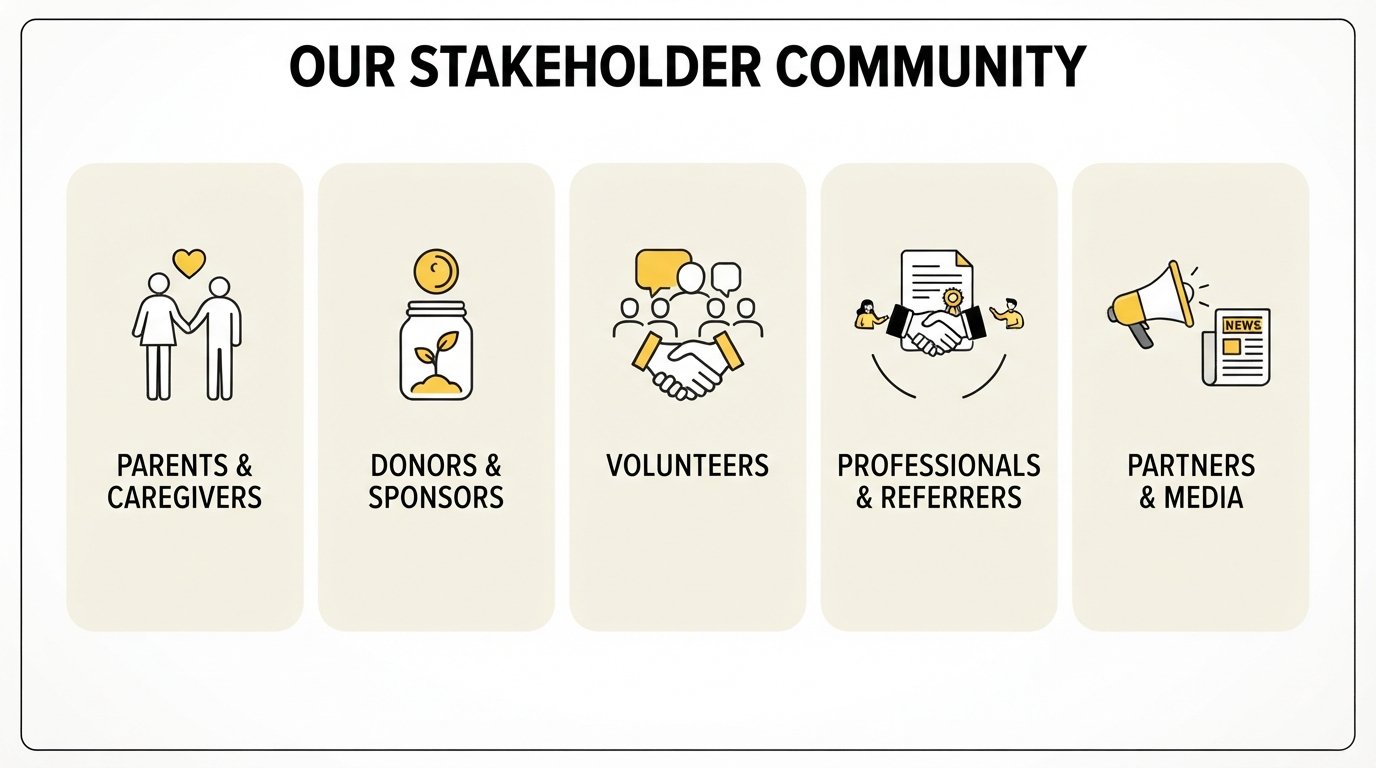
It is the planned use of social media to support your organization’s mission. Unlike a business, a nonprofit usually has several audiences at once: families looking for services, donors, volunteers, professionals who might refer people to you, and community partners. Good social media marketing speaks to each of them clearly and honestly.
It is a part of digital marketing for nonprofits, which also includes your website, email, WhatsApp, search engine visibility and online fundraising. Social media is often the easiest place to start because it is low-cost and your audience is already there.
Step 1: Set clear goals
Before you post anything, decide what you want social media to achieve. Choose two or three goals, not ten. Examples for a special needs organization:
- Increase parent inquiries or admissions by a specific number each month.
- Recruit volunteers for events and programs.
- Raise awareness of your services in your city.
- Build relationships with schools, doctors and community partners.
- Support fundraising campaigns, and show clearly how donations are used.
Make each goal measurable and give it a time frame, such as “receive 15 parent inquiries per month through social media by the end of June”.
Step 2: Know your audiences
Write one short profile for each group you want to reach. For example:
| Audience | What they want to know | Best content |
|---|---|---|
| Parents and caregivers | Can you help my child? Can I trust you? | Services explained simply, team introductions, parent tips |
| Donors and sponsors | Where does my money go? What changes? | Transparent updates, project reports, thank-you posts |
| Volunteers | How can I help? | Clear roles, dates and sign-up links |
| Professionals and referrers | Is this organization credible? | Qualifications, approach, events |
| Partners and media | What do you do and why does it matter? | Awareness-day campaigns, press-ready summaries |

Step 3: Build your nonprofit branding
Nonprofit branding is how your organization looks, sounds and feels everywhere people meet it. A clear brand builds trust, which matters even more when families are making decisions about their children’s care. A solid brand has these parts:
- Name and tagline. Keep your name consistent across every platform. A short tagline should say who you serve and what you do.
- Logo. It should be clear when small, such as in a profile picture.
- Colors and fonts. Choose two or three colors and one or two fonts. Check that text is easy to read against its background, since many followers use phones outdoors or have low vision.
- Voice. Decide how you speak. For special needs organizations, a calm, warm, plain and respectful voice works best. Avoid pity language and avoid promising outcomes.
- Photo and video style. Use real, consented photos where possible and keep a consistent look.
- Brand guidelines. Put these decisions into a one-page document so your whole team, and any agency you work with, posts in the same way.
Quick branding checklist
- Same name, handle and profile picture on every platform
- A bio that states who you serve and where you are
- A link to your website and a clear way to contact you
- A color palette and fonts written down
- A short note on tone of voice and words to avoid
Step 4: Choose the right platforms
Do not try to be everywhere. Pick the platforms where your audiences actually are, and do those well.
| Platform | Best for | Notes |
|---|---|---|
| Parents, community groups, events | Works well for local organizations in Pakistan. Use it for event pages, updates and group discussions | |
| Visual stories, awareness days, short videos | Good for reels, carousels and stories. Use alt text on images | |
| Donors, partners, professionals, hiring | Use it for credibility, reports and partnerships | |
| Direct communication with families and volunteers | Use a broadcast list or community group, with permission | |
| YouTube | Longer explainers, webinars, training | Add captions to every video |
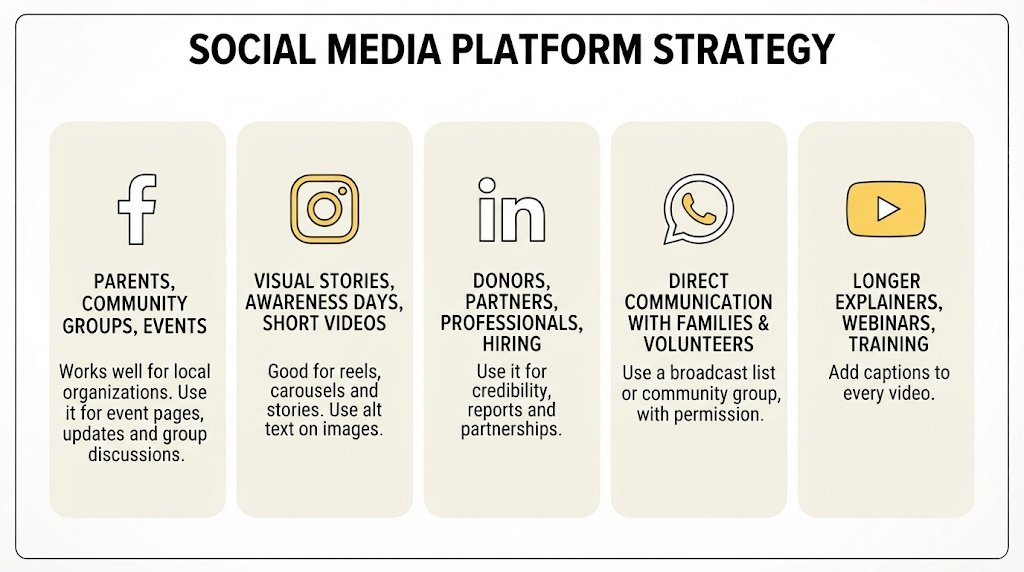
For a small team, a good starting point is Facebook and Instagram, with LinkedIn added if you need donors or partners.
Step 5: Plan your content pillars
Content pillars are the repeating themes your posts fall into. They keep you from running out of ideas. Six work well for special needs organizations:
- Education. Plain-language explainers, myth versus fact graphics and parent tips.
- Stories and impact. Real stories shared with written consent, focused on strengths and progress.
- Behind the scenes. Introduce your team, your center and a normal day.
- Awareness days. Autism Awareness Day, Down Syndrome Day, Disability Day and other dates.
- Community and partners. Thank volunteers, sponsors and partner schools.
- Calls to action. Invite people to book a visit, volunteer, share a post or donate.
Nonprofit social media ideas you can use this month
- A “myth versus fact” graphic about disability or neurodiversity
- A short video introducing a therapist or teacher
- A “day in the life” of your center, with no identifiable children unless consent is in place
- A simple tip for parents each week
- A volunteer spotlight
- A thank-you post to a donor or partner
- A countdown to an event or awareness day
- A fundraising update showing what funds were raised and how they were used
- A question to your audience, such as “what would you like to learn about?”
- A short explainer in Urdu and English
- A recording or highlights from a workshop
- A behind-the-scenes look at how you prepare for an event
For more nonprofit marketing ideas tied to a specific date, see our guide to autism awareness day ideas for centers and schools.
A four-week nonprofit social media calendar
This nonprofit social media calendar shows how three or four posts a week can cover your content pillars. Adapt the topics to your organization.
| Week | Monday | Wednesday | Friday | Weekend |
|---|---|---|---|---|
| 1 | Introduce your mission (video or graphic) | Parent tip | Team member introduction | Thank-you post |
| 2 | Myth versus fact | Behind the scenes | Volunteer call | Community or partner post |
| 3 | Service explained simply | Awareness day or event countdown | Story (with consent) | Question to your audience |
| 4 | Donation or support update | Parent tip | Event recap or reminder | Month review and thank-you |
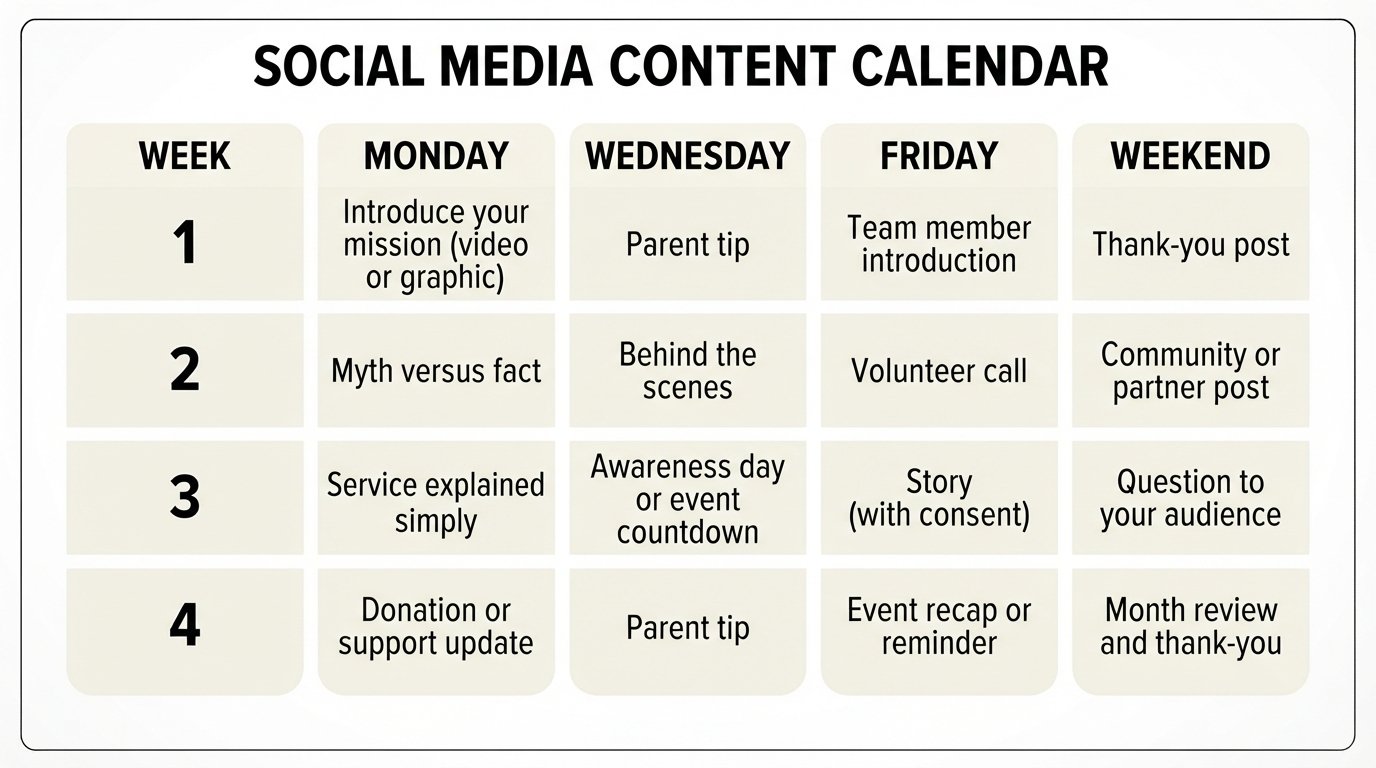
Write and schedule posts in batches, such as one afternoon each week or one day each month. This is far easier than posting on the spot.
Nonprofit marketing plan template
A nonprofit marketing plan puts your goals, audiences, messages, channels and budget in one place. Here is a simple template you can copy.
- Summary. In two or three sentences, describe your organization and what this plan aims to achieve.
- Goals. Two or three measurable goals with a time frame.
- Audiences. The groups you want to reach and what each needs to hear.
- Key messages. Three or four short statements that explain what you do and why it matters.
- Channels. The platforms and tools you will use, and why.
- Content plan. Your content pillars, posting frequency and a monthly calendar.
- Calendar of key dates. Events, awareness days and fundraising periods.
- Budget. Money, staff time and any agency or ad costs.
- Roles. Who creates, approves, posts and replies to messages.
- Measurement. The numbers you will track and when you will review them.
Sample nonprofit marketing plan
Below is an example for a fictional organization, “Example Center”, a small therapy center for children with developmental needs in Karachi. It is only an illustration. Replace every detail with your own.
- Summary: Example Center wants more families to find and contact it through social media over the next six months.
- Goal 1: receive 15 parent inquiries per month through Facebook and Instagram by month six.
- Goal 2: recruit 10 volunteers for two community events.
- Audiences: parents of young children, local schools and pediatric clinics, volunteers from local universities.
- Key messages: “We support every child’s strengths”, “Families are partners in our work”, “Our team is trained and caring”.
- Channels: Facebook and Instagram for families, LinkedIn for partners.
- Content plan: three posts per week across the six pillars, in Urdu and English.
- Key dates: Autism Awareness Day on 2 April, World Down Syndrome Day on 21 March, International Day of Persons with Disabilities on 3 December.
- Budget: staff time of about five hours per week plus a small monthly amount for boosting selected posts.
- Roles: the center manager approves posts, a staff member replies to messages, and a volunteer designs graphics.
- Measurement: track inquiries, reach, engagement and website visits, and review them on the first day of each month.
Digital marketing for nonprofits on a small budget
You do not need a large budget to start.
- Use free tools. Free design tools, scheduling tools and your phone camera are enough to begin.
- Use volunteers carefully. Students and volunteers can help with design and photography, but a staff member should always review and approve what is published.
- Boost selectively. A small paid boost on your best-performing posts, such as an event invitation, can reach more local families. Set a clear limit.
- Check nonprofit programs. Some platforms and software companies offer discounts or free tools to registered nonprofits. Check whether your organization is eligible where you are.
- Reuse content. One workshop can become a video, a quote graphic, a photo post and a parent tip.
Make your social media accessible
An accessible social media presence is especially important for disability organizations, because many of your followers rely on it.
- Alt text. Describe each image in a short sentence so screen reader users know what it shows.
- Captions. Add captions to every video.
- Plain language. Use short sentences and avoid jargon.
- Readable colors and fonts. Keep strong contrast between text and background.
- Hashtags. Capitalize each word, such as #WorldAutismAwarenessDay, so they are easier to read, including with screen readers.
Protect the dignity and privacy of the people you serve
- Get written consent from a parent or guardian before posting any photo, video, name or story involving a child.
- Focus on strengths and the support you provide, not on pity or suffering.
- Do not promise cures, results or outcomes.
- Give families an easy way to withdraw consent, and remove content when they ask.
- Where possible, include autistic and disabled people and parents in deciding how you tell your story.
How to measure your results
Track a few numbers each month, and compare them with your goals:
- Reach and impressions: how many people saw your posts.
- Engagement: likes, comments, shares and saves.
- Messages and inquiries: how many families contacted you, and from which platform.
- Website visits: how many people came from social media to your site.
- Volunteers and donations: sign-ups and contributions linked to your campaigns.
Inquiries and sign-ups matter more than follower counts. Ask each new family how they found you, and write it down.
Common mistakes to avoid
- Posting without a plan or a goal.
- Being on too many platforms with too little time.
- Using the same pity-focused language that many families find hurtful.
- Posting children’s photos without consent.
- Only asking for donations and never giving anything useful.
- Ignoring comments and messages, which families may rely on to contact you.
- Not tracking results, so you cannot learn what works.
Frequently asked questions
- What is social media marketing for nonprofits?
It is the planned use of social media to support a nonprofit’s mission: reaching the people you serve, finding volunteers and supporters, building partnerships and encouraging donations. It works best when it is based on clear goals, clear audiences and a consistent brand. - What is the best social media platform for a nonprofit?
It depends on your audience. Facebook and Instagram work well for reaching families in Pakistan, LinkedIn suits donors and partners, WhatsApp is useful for direct communication, and YouTube suits longer explainers. Start with one or two and do them well. - How often should a nonprofit post on social media?
For a small team, three to five posts per week is a realistic starting point. Consistency matters more than volume, so choose a pace you can keep up for months. - What should a nonprofit marketing plan include?
A good plan includes a short summary, measurable goals, audiences, key messages, channels, a content plan, a calendar of key dates, a budget, roles and a way to measure results. The template in this guide covers all of these. - How much should a nonprofit spend on social media?
There is no fixed amount. Many small nonprofits start with staff time and free tools, then add a small paid budget to boost their best posts or event invitations once they know what works. - Can a nonprofit use an agency for social media marketing?
Yes. An agency can plan, create and manage your content so your team can focus on programs. Choose one that understands your sector, respects consent and privacy, and reports clearly on results.
Need help with social media marketing for your nonprofit?
Yellow Advertisers is a Karachi-based special needs marketing agency. Our monthly package covers complete branding and social media management for autism centers, special needs schools, therapy clinics and disability nonprofits, in Urdu and English. Pricing varies by organization.
See our social media marketing service for autism and special needs centers, or book a free call with Dawood.
